
1. Microvita: Philosophical and Physical Premises
Introduction
There is a persistent gap between physics and the emergence of life and individual consciousness. As this is not because these phenomena necessarily lie outside physics, it could be that current methodology does not adequately account for the kinds of physical organization through which they occur. These could, for example, include forms that cannot be fully captured quantitatively alone.
This suggests that the difficulty may not lie in the phenomena themselves. In particular, what appears as a fundamental divide between conscious experience and physical processes may reflect an incomplete way of interpreting the latter, rather than a genuine ontological discontinuity.
The so-called “hard problem” of consciousness can be seen in this light (Chalmers, 1995). It arises from the expectation that experience is entirely derived from processes in the brain, while at the same time treating what is qualitative as necessarily subjective, and therefore as lying outside the domain of physical inquiry. However, that which is already objectively perceived, even while qualitative in nature, need not therefore be expelled from inquiry, nor was its subjectiveness ever compelled by physics. Instead, qualitativeness may point toward categories not presently articulated within physical theory. If certain configurations are both qualitative and objectively present, the apparent divide between physical processes and experience may reflect inadequate or missing classifications rather than a fundamental gap.
However, a deeper complication lies in the ambiguity of the term “consciousness” itself. It is often used to refer both to individual experience and to what underlies the possibility of experience. When this distinction is not explicit, questions about consciousness risk conflating different categories: the enabling factor may become tacitly absorbed into experience itself, thereby causing the latter to appear ontologically discontinuous from physical reality.
At the same time, related tensions are already present within physics. Questions ranging from the emergence of classical behavior from quantum systems and the role of the observer, to the status of gravitation and the so-called dark sector indicate that key concepts in physics remain unresolved. An impulse toward ontology in physics does not arise from within physics itself, but is a human-cultural one. It is prompted, however, when attempts to extend physics beyond its present scope — as indicated by the tensions encountered — no longer sustain a purely instrumental interpretation.
As Emre (2025) observes in his broader examination of physical understanding, “A deeper theory is not a reductionist theory. On the contrary, a deeper theory will explain a wider range of phenomena.” Taken together, these considerations suggest that what is missing is not a new class of phenomena, but a form of organization that is not reducible through local quantification, yet not external to physical theory either. A natural way to approach this is to expand physical legibility by considering an intermediate domain, situated between the ordinary dynamical categories in physics, and specialized regimes characteristic of life and conscious experience.
Re-examining the premises of the hard problem, while retaining the deeper categorial distinctions, thus opens a line of inquiry that extends physics without requiring additional metaphysical postulates. Such a domain would not introduce fundamentally new ingredients, but would instead provide a way of understanding how viable processes close into stable, self-consistent forms. In biological systems, such closure appears through tightly integrated sensorimotor organization; more generally, it marks the point at which physical dynamics become self-consistent and capable of coherent, organized behavior.
The aim of this work is to explore this possibility and to examine how such a domain might be developed within a broadened, yet still physical, framework.

Closing a Structural Gap in Physical Theory
Developing new categories for deeper legibility in physics reveals that biological forms occupy a uniquely intermediary role, situated not only between the physical micro- and macrocosmic scales, but also between ordinary dynamical categories in physics and the organized regimes through which life and conscious experience become manifest.
Biology's role becomes evident through its sensorimotoric closure. The perception side has been approached as qualitative without therefore being subjective. Motoric expression, by contrast, is quantitative in its very mode of operation, since it must resolve into directed, measurable activity. The deeper significance of the sensorimotoric apparatus, however, lies in the fact that the two sides cannot reasonably be considered as merely instrumentally linked: the quality of awareness and quantitative expression form a dynamic, experientially closed circuit. In this light, the motoric side cannot be treated as simply objective in the ordinary physical sense. Its quantitativeness is instead part of an intrinsic and more comprehensive energetic organization of biological systems.
The manifest world, which cognitively developed biology reads as a classical, differentiated physical reality, possessing ontological status in and of itself, may, from this expanded physical vantage, signify a systematic, bifurcated manifestation of a deeper, degenerate continuity. What stabilizes as closure-sensitive equilibrium in biology itself might equally be traced back to known categories across a much broader physical spectrum.
This extended reading suggests that closure-sensitive regimes are not restricted to biological forms. Rather, biology progressively consolidates and radicalizes the broader bifurcative spectrum into a fully reciprocal closure, while, in principle, remaining legible as an extended physical category. The broader physical spectrum thus already exhibits a wide range of viable structures, from atomic and molecular stability, to bio-molecules, to large-scale cosmological structure. While these regimes differ profoundly in structure and complexity, they nevertheless suggest that physical reality may itself emerge through varying forms of bifurcative stabilization.
From this perspective, local physical forms need not be understood as reflecting an ontological discontinuity. Rather, they may indicate a degenerate progression, tentatively extending between Lorentz-invariant regimes and what may be understood as an underlying actional or S²-oriented framework. Physically, this could include, for example, stable configurations in the bio-chemical domain, associated with molecular conformation and bio-molecular structure.
Toward an Intermediate Domain
In June 1989, Shrii P.R. Sarkar convened a small garden meeting that would later become known as the ‘blackboard session' (Sarkar, 1991, "Microvita and Cosmology"), and which formed the culminating chapter of a series of discourses on Microvita Theory initiated in December 1986.
In the course of the 2.5 years leading up to this scholarly meeting, Sarkar’s Microvita series developed what appears to be a novel cosmological orientation, covering topics ranging from psycho-spiritual and devotional concerns to increasingly physics-adjacent exploration. What complicates a comprehensive reading is not only the sheer breadth and conceptual novelty of the material, which by itself does not strongly constrain interpretation, but also the fact that the surviving transcriptions of this largely oral tradition require careful scholarly scrutiny.
In his recent examination of Sarkar's Tantric ontology, Hewitson (2026) expressly sets Microvita Theory aside, anticipating that “future studies of microvita theory will deepen the connection between matter and consciousness”. In order that the Microvita framework may help articulate the missing intermediate domain between physics and the emergence of life and individual consciousness, it is approached here not primarily through the classification of hypothetical microscopic living entities, nor as a ready-made scientific doctrine, but as a partially stabilized cosmological vocabulary converging remarkably well with known deep physical categories.
The following scheme formed the culmination of the series and is taken verbatim from its publication (Sarkar, 1991, “Microvita and Cosmology”):
| Subjective | Objective | |
|---|---|---|
| (A) | Knowing principle or supra-mundane knowledge. (Expressed energies of different characters – indestructible, interchangeable and inter-transmutable.) | Planes of microcosmic and Macrocosmic propensities. (Different strata of mind: conscious, subconscious, physico-psychic, psycho-physical and psycho-spiritual.) |
| (B) | Doing principle or supra-mundane seed of the actional principle, ready for being sprouted. (Microvita of different characters, either of positive or negative nature, collectively maintaining the balance of the actional universe creating initial forms of carbon atoms that help macro- and micro-propensities in having their pure physical auxiliary media with mass and wonts.) | Planes of universal Macrocosmic inferences and their reflected or refracted inferences. (Planes of inferences which are being activated, accelerated and stimulated by (A) subjective.) |
(A) subjective relates to and controls (B) objective, and (B) subjective relates to and controls (A) objective (Sarkar, 1991, “Microvita and Cosmology”).
A few remarks may help orient the present reading:
The qualitative versus quantitative, and objective versus subjective categories developed throughout the preceding philosophical and physical sections become recognizable in this highly condensed table. It suggests that the latter should not primarily be read as a metaphysical classification, but as an attempt to capture the extended relations between “knowing” and “doing” orientations within a physics-adjacent picture. The four Faculties of Sarkar's Microvita-based cosmology appear to align strikingly well with the bifurcative and closure-sensitive model developed here (Sarkar, 1991).
In particular, upon closer examination, it becomes apparent that the “Known” pole or faculty concerns that which is directly perceived, namely (A) Obj., rather than that which is understood or inferentially reconstructed. The latter clearly identifies (B) Obj., the quantitative physical category which Sarkar annotates as the “Done” portion.
Whatever the eventual scientific status of the Microvita framework, the physical and ontological questions it raises appear increasingly difficult to ignore. In this sense, Sarkar’s call to initiate systematic research into these domains may today be read less as a doctrinal program than as a still unresolved scientific and philosophical challenge.
Outlook
The conceptual novelty of both the philosophical and physical background developed here, as well as P.R. Sarkar’s Microvita Theory, indeed pose a considerable research challenge: namely, whether an intermediate domain may exist between physics, life and individual consciousness.
While an (A)-axis has been identified in relatively straightforward sensorimotoric terms, its operational Faculties invert conventional epistemic distinctions between 'subjective' and 'objective', revealing its distinct ontological status. This inversion does not apply to the bifurcative or (B)-axis, proposed here as a degenerate continuum, through which conventional epistemic intuition primarily operates.
However, the corresponding Faculties of the latter remained comparatively underexposed. This may not be unrelated to the fact that the (B)-axis appears to form the deeper physical spine of the unified scheme. Not surprisingly, Sarkar suggests that “(B) objective is the field of external laboratory research.”
In contrast, the subjective Faculties would belong to the field of “psycho-spiritual laboratory research”. Importantly, this differs from claiming that such domains are unrelated to physics altogether — hence still the “laboratory” cue.
While the quantitative side, which was carefully approached here through motoric expression, can no longer be treated as simply objective, Sarkar directly identifies (A) Subj. both as “Knowing Principle” and as “Expressed energies...” (ref. Four Chambers scheme). This appears to capture its ontological subjectivity as a conserving resp. conserved condition that is itself not directly measurable, but rather deduced through measurement within (B) Obj. — a distinction which even physics may not always fully appreciate.
A similar observation may apply to the qualitative side, that is specifically (B) Subj., identified as “Doing principle or supra-mundane seed of the actional principle”. Here, another important connection with physics becomes difficult to ignore. While energy appears in physics as a conserved quantity, the Action Principle instead concerns the stationarity of dynamic trajectories in physical systems. Importantly, “Action” in this context does not imply external or Newtonian action, but rather an integral formulation governing the admissible evolution of physical systems as a whole. Indeed, it is among the deepest and most powerful organizing principles in modern physics, even if often regarded primarily as a mathematical convenience.
The same may also be approached from a more explicitly physical perspective, emphasizing the qualitative and quantitative dimensions as operative sides of the unified scheme:

In modern physics, Noether’s theorem had already placed Action at the center of lawful — or indeed qualitative — conservation relations, even if its deeper ontological status has remained comparatively unresolved ever since (Noether, 1918). As Louis de Broglie noted already in his seminal 1924 paper:
“Nevertheless, action is a very abstract notion, and as a consequence of much reflection on light quanta and the photoelectric effect, we have returned to statements on energy as fundamental, and ceased to question why action plays a large role in so many issues.” (de Broglie, 1925/2004, p. 8)
It is therefore striking that Sarkar places it in precisely this register: “… maintaining the balance of the actional universe.”
2. Topological Guna Theory
This section explores an ontological reading of present-day physics and mathematics, inspired in substantial part by Sarkar's axiomatic guna theory, with the aim of more precisely positioning microvita within a theoretical framework that may eventually inform practical investigation and application. An earlier contribution to the dialogue between Sarkar's cosmology and Western science is Towsey's Eternal Dance of Macrocosm (2011), which approaches their relationship through a broad encyclopaedic synthesis.
Topological Guna Theory (TGT) is a synthetic ontogeneric proposition that regards familiar objectual properties, such as mass, size and orientation, as well as electromagnetic and gravitational interactions, as differentiated expressions of integrally constituted physicality. Rather than taking the objectual condition as ontologically given, TGT explores whether its integrality may be inferred from the stationarity of physical action, and whether that stationarity may in itself admit an antecedent configuration, rather than being understood solely as a property of already established objectual reality.
The central ontological move in this work is to take action structurally seriously. “Action” here refers to the precisely defined principle in physics by which an entire physical trajectory or transformation can be represented in a single, integral formulation. In conventional mechanics and field theories, action is expressed as an integral over the system's dynamical evolution. The physically realized evolution is determined by the condition that this action is stationary under sufficiently small variations:
\[
S[q] = \int L(q,\dot q)\,d\tau,
\qquad
\delta S = 0
\]
Conventionally, this formulation begins with already constituted physical variables and asks which of their possible evolutions satisfies stationary action. Here we ask the reverse ontological question:
whether the integral stationarity of action may itself provide a bearing for physical differentiation, that is, prior to its resolution into distinct, proprietary physical actions. This reverses no equation of conventional physics and is not proposed as a necessary consequence of the principle of stationary action. It is an ontological reading motivated in part by Sarkar's distinction between actional differentiation and its integral substantiation. The ensuing construction should be read under this premise.
The next step is therefore not to introduce a new physical principle, but to examine more closely how action is already organized in standard physics. In particular, its canonical form expresses the conjunction of configurational and temporal contributions within a single integral action. This provides a technically defined starting point for investigating the proposed relation between stationarity and objectuality:
Nothing new has been added to the physics. The Legendre transform merely reformulates the action of an already constituted physical system. It does, however, allow configurational contributions to be distinguished from its temporal expression, within a single canonical structure. This mathematical transformation reveals a marked analytical distinction within the stationary action, which is common to otherwise vastly disparate physical systems. As we shall see in the forthcoming section on microvita and physics, the Hamiltonian contributions acquire ontogeneric significance in actual macrocosmic formation.
TGT begins with ordinary three-dimensional physical reality and the established, distinct physical bearings of spinoriality and gravitation. It takes these as empirical premises, without thereby granting them antecedent ontological status. TGT examines these bearings topologically, in terms of their respective characteristic dynamical expressions: rotationality in the spinorial case, and directionality in the gravitational case. At the outset, rotationality is represented by the familiar rotation group SO(3), while directionality is represented by the sphere of oriented directions, S². Their pivotal roles in examining the physical bearings and, eventually, in microvita theory are the subject of the ensuing investigation.
Rotationality in objectual space is characterized by the topology of the three-dimensional rotation group, (SO(3)):
\[ \pi_1(SO(3))=\mathbb{Z}_2 \]
In topological terms, this reads as follows: a completed 360° rotational loop cannot be continuously contracted to a point, whereas its 720° double can. Contractibility here means that a closed path can be continuously reduced to a point without breaking its continuity. In empirical terms, this means that an object can return to its original orientation after a full rotation, while the path of that rotation remains topologically nontrivial. The apparent completion of the object's rotation does not necessarily imply completion of its transformation. In physical terms, this distinction finds expression in the spinorial structure of quantum mechanics, where a 360° rotation of a spin-½ internal state changes its sign, while a 720° rotation restores it.
Directionality is characterized by the topology of the space of oriented directions in three dimensions, independently of a metric:
\[ \pi_2(S^2)=\mathbb Z \]
In topological terms, this reads as follows: although any individual direction can be continuously changed into another, the entire spherical organization of directions cannot be continuously contracted to a single direction while preserving its global topological structure. In empirical terms, this means that the surrounding field of directions, familiar to us as the sky, can be continuously distorted, stretched or compressed, but cannot be reduced to a single direction without losing the continuity of the mapping. In physical terms, this distinction becomes particularly intelligible through relativistic aberration, which continuously redistributes apparent directions with relative velocity, while preserving the complete directional sphere for every velocity below that of light.
The difference between these two properties becomes apparent in the following illustrations: one involving an object we can rotate, the other the sky that surrounds us:
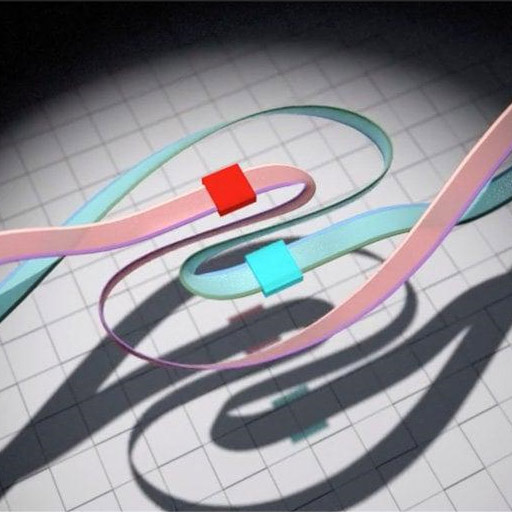
Rotation: A natural appearance, an extraordinary transformation
The "belt trick", introduced by Paul Dirac around 1929, shows how an object returns to its original orientation after 360°, while its rotational path remains topologically nontrivial. Only after 720° can the double traversal be continuously undone.
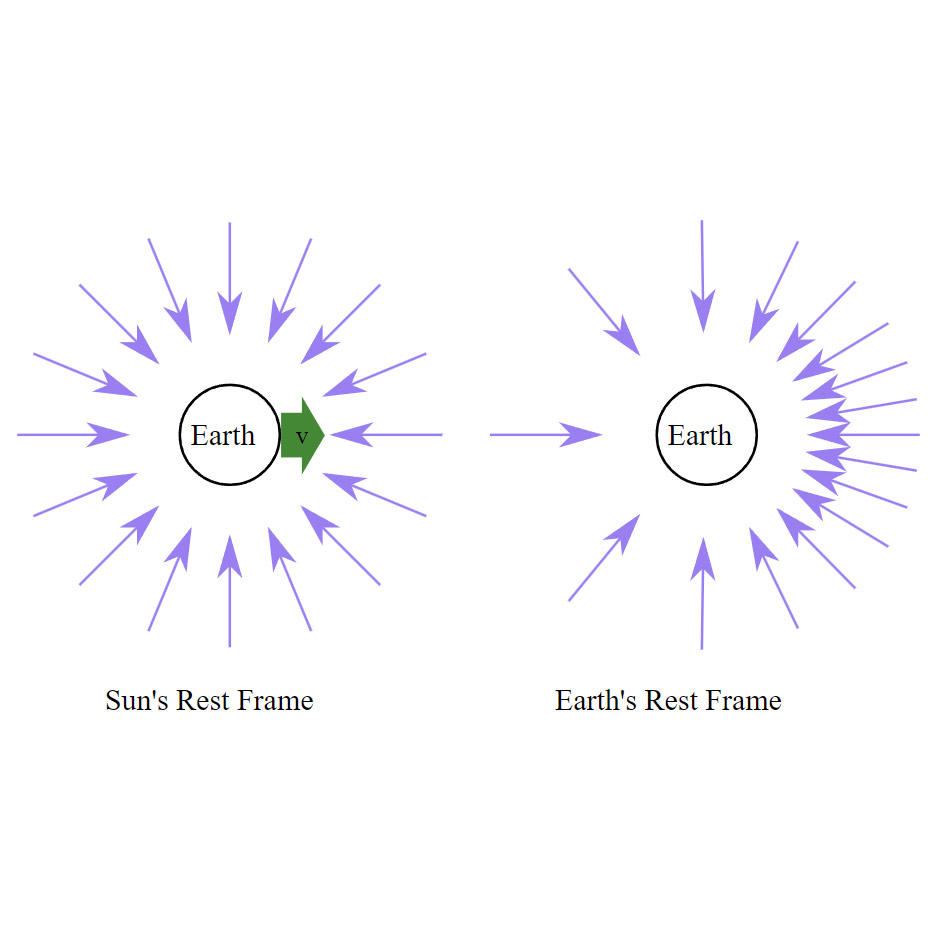
Directionality: An extraordinary appearance, a natural transformation
Stellar aberration, first discovered by James Bradley in 1727, shows how the apparent distribution of directions changes continuously with velocity.
These two topological properties are mathematically distinct. Neither introduces a new physical principle, and neither, by itself, determines the corresponding physical theory or its characteristic constant. They nevertheless provide two nontrivial, systematic readings within the same empirically established spatial setting, whose physical realizations can be examined through canonical action. Familiar as this setting may seem, both aspects are subject to the topological properties just described. Their expression in physical phenomena is what we shall refer to as the characteristic bearings of those phenomena.
The purpose of TGT is not merely to demonstrate that physical reality exhibits properties that, from our everyday vantage point, appear anomalous. Rather, it is to explore how these very properties make objectual perception, and ultimately the inference of material reality itself, possible in the first place. Indeed, to anticipate our more detailed exploration of microvita, P.R. Sarkar places microvita and energy on the "silver line of demarcation between matter and abstract" (Sarkar, 1991, “Matter and Abstract”), distinguishing the realms of sensory perception and mental conception.
There is a seeming paradox here. The canonical formulation of action describes the dynamics of an already constituted physical system, yet its configurational and temporal contributions allow us to investigate what may be inferred as antecedent to that very constitution. TGT does not propose an additional physical mechanism, but explores whether the characteristic bearings of established physical phenomena may disclose a common centre that cannot itself be identified with either bearing in isolation.
The rotational and directional bearings thus enter our ordinary experience together: in the objects we perceive and manipulate, and in the surrounding space in which they appear and move. The question that naturally arises is not merely how these phenomena behave, but what their conjunction may tell us about the very possibility of objectual experience in the first place. We shall first examine their physical expression in the spinorial behavior of particles and the workings of gravitation.


TGT seeks an ontological synthesis of these physical bearings, rather than their conventional physical unification. Physics does not ordinarily need to ask the ontological question pursued here: it describes physical interactions, transformations and invariants without having to establish the objectual condition itself. TGT examines the spinorial and gravitational bearings in relation to a single, common inferential axis between stationarity and objectuality. Their respective canonical actions share a similar structure, while their rotational and directional properties reveal a direct topological relation. Although their physical expressions remain distinct, the sphere of spatial directions can be represented as the standard quotient of the rotation group:
\[ S^2 \simeq SO(3)/SO(2) \]Importantly, the quotient relation does not resolve the physical non-reductivity of the two bearings. Rather, TGT interprets \(S^2\) as the topological sphere into which the directional characteristics are resolved, and the vastly disparate physical bearings conjointly substantiated. Phenomenologically, this inferred centre appears as the nucleus, or characteristic bearing, of the entire objectual condition. The quotient relation warrants a closer reading, which is detailed in the insert below.
The concept of an ontological centre or nucleus is prominent in guna theory, formulated by P.R. Sarkar (1996, Chapter 4), which, as mentioned, inspired this work. It presents a highly axiomatic account of how an antecedent homeomorphic state gives rise to a wave-like medium. Its account of objectual emergence aligns with TGT's inferential axis, although guna theory does not explicitly address the two distinct physical bearings through which TGT develops its ontological inference.
The gunas signify three primordial creative "forces" or principles, typically characterized as phasic trends within an expansion–contraction dynamic. The gunatrikona expresses trivalent mutual coherence prior to physical expression. The ontological nucleus in guna theory, described as the thread wherewith the midpoints of numerous such guna-triangles are interwoven, nevertheless calls for a more layered treatment, for which TGT develops a topology structured through the canonical physical action. Conversely, TGT seeks to bring greater physical and mathematical precision to the philosophical conception of the three gunas.
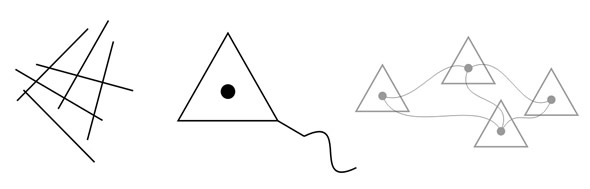
The gunatrikona and its global threading. Philosophical depiction. In the homomorphic phase, the gunas are present and active, yet mutually indistinguishable. During autogenesis, the gunatrikona becomes discernible, expressing a configurational, dynamic equilibrium. Each gunatrikona is globally threaded with all others, signifying their common characteristic bearing.
While the outward action of the gunas proceeds from a vertex of the nucleus's trivalent configuration, the nucleus itself remains central, distinct from the point of emergence. A corresponding distinction is developed in TGT by elevating the stationarity of physical action to a complementary inferential pole. This move, while consistent with established physics, is perhaps TGT's most distinctive feature, and provides a basis for a more precise characterization of the gunas.
While the rotation group \(SO(3)\), together with its quotient relation, characterizes the objectual inference (empirical reality), a topological, non-reductive counterpart that similarly accommodates the rotational and directional bearings is found in the three-sphere, or \(S^3\) (commonly realized as the space of unit quaternions; see the Quaternions insert). The standard topological relation:
\[ S^3/S^1\cong S^2\]
expresses the quotient relation of the Hopf fibration , which maps the three-sphere \(S^3\) onto the sphere of directions \(S^2\), with each circle fibre \(S^1\) corresponding to a single point on \(S^2\). Inspired in large part by guna theory, TGT then associates \(S^3\) with an antecedent stationarity principle that does not presuppose already constituted objectuality. With \(S^2\) common to both quotients, TGT's inferential axis can thus be represented schematically as:
Hopf fibration is detailed in the insert. Thus, TGT gives stationarity its own ontological bearing, while the common sphere of directions, \(S^2\), identified with "kendra" in TGT's philosophical interpretation, also evokes the centre into which all directionality is resolved. By way of illustration, the three-sphere \(S^3\) may be thought of as topologically encompassing \(S^2\), somewhat analogously to how the philosophical gunatrikona “encircles” the nucleus. In this sense, \(S^3\) could loosely be viewed as a topological “guna vault”, in which the gunas, understood as phasic trends, remain mutually indistinguishable.
The substantiation of TGT's inferential axis is intimately tied to the stationarity of the action, ontologically placed opposite to the objectual inference. As mentioned earlier, the action in TGT is not a property of an already established physical configuration, but ontologically primitive. The actional expression is proposed to have the following characteristics:
|
Scale-invariant |
Across physical micro- and macrocosmic scales |
|
Globally threaded |
Sarkar's "threadedness" of the nucleus |
|
Nontrivially integrable |
Substantiating |
|
Nonlinear |
Generative |
|
Additive synthesis |
Objectual expression |
TGT proposes a single condition under which nonlinear and additive phasic synthesis become nontrivially integrable, thereby constituting threaded objectuality. A general correspondence already exists in the form of a scaled activation \(K_i\) of the respective fibrations, whereby each admits the same composite waveform. This establishes a mathematical bridge between the respective inferences, but does not in itself confer any further significance. A substantial bridge was found, largely serendipitously, in the form of a Golden Ratio -scaled activation \(K_\Phi\) of the respective fibrations. The proposed realization was originally developed through Fourier analysis of \(K_i\). \(K_\Phi\) was found to exhibit not only a wavenumber-doubling invariance \(1k_n \rightarrow 2k_n\), but also a globally integrable composite \(\int K_\Phi\), which is phase-aligned with the reference phase. The appearance of doubling and \(\Phi\) in the proposed ontology recalls an earlier investigation of these relations in the direct perception of sound and colour (van den Bovenkamp, 2025). An interactive demonstration of the \(K_\Phi\) synthesis, with adjustable scaling ratio and phase, is available online.
The double covering of \(SO(3)\) by \(S^3\) establishes an intrinsic degeneracy : two antipodal configurations correspond to the same spatial rotation (see insert). Across TGT's inferential axis, the \(\Phi\)-scaled activation \(K_\Phi\) admits a global, nontrivially integrated phasic expression. TGT proposes that this special condition makes the underlying degeneracy available for substantiation through the common \(S^2\), understood as globally threaded objectuality. Indeed, TGT views substantiation as fundamentally volitional .

Topological Guna Theory. The gunatrikona represents the configurational bearing, while the outward wave depicts the integral phasic flow between stationarity and objectuality. In TGT, the philosophical kendra encompasses both, acquiring a more explicit integral interpretation. \(\mathcal{S}_\Phi\) denotes its volitional substantiation.
Even the most detailed mathematical or philosophical ontogeneric description does not, in itself, account for its actual substantiation. As outlined, TGT is fundamentally an inferential approach grounded in a nonreductive physical bearing. Yet neither of its two characteristic bearings alone, nor even their topological alignment, accounts for empirical substantiation.
The identification of the abstract two-sphere \(S^2\) as their common ontogeneric bearing, however, presents a remarkable possibility. TGT proposes that its apprehension as an actual, finite geometrical sphere , and the familiar conception of classical objectuality as “things moving and tumbling around in a large container,” are not separate phenomena. Rather, they constitute one and the same expression of the degeneracy of the underlying topological configuration.
Indeed, TGT views substantiation as fundamentally volitional , not necessarily in the sense of a willful act, but as an intrinsic tendency toward individuation. This degeneracy may therefore be understood as intrinsically progressive: substantiation is not exhausted by its topological formulation, but unfolds as an evolutionary expression of increasingly specialized conditions, including objectual identification and ultimately bodily self-identification .
Thus, the ontogeneric synthesis of TGT returns to its empirical premise: the world of objects, no longer taken as independently given, is understood as the substantial expression of canonical action, now invested with ontogeneric significance.
In closing, this exposition of Topological Guna Theory has presented a synthetic proposition inspired in great part by P. R. Sarkar's principal philosophical treatise. A few of his powerful aphoristic strokes, drawn from different chapters (Sarkar, 1996), deserve special recognition and are reproduced here, together with their translations, verbatim and without commentary:
A.S. 1-4. Paramashivah Purus´ottamah vishvasya kendram.
[Supreme Consciousness at the nucleus of the universe is known as Paramashiva or Purus´ottama.]
A.S. 1-7. Drk Purus´ah darshanam´ Shaktishca.
[Purus´a is the substantiator, the ultimate witness; (the actional faculty of) Prakrti is the act of witnessing (and that which is witnessed).]
A.S. 2-14. Brahma Satyaḿ jagadapi satyamápekśikam.
[Brahma is Absolute Truth; the universe is also truth, but relative.]
A.S. 4-3. Prathama´ avyakte Sa´ Shiva´nii kendre ca Paramashivah.
[In the first stage (not yet a stage of actual manifestation), Prakrti is called Shiva´nii, and the witnessing Purus´a at the nucleus is called Paramashiva.]
3. Toward a Physics of Microvita
When a physicist speaks of symmetry, the term refers not merely to geometrical regularity, but more fundamentally to invariance under transformation. A physical law is symmetric under a transformation if its form remains unchanged. In rudimentary terms, physical action may be approached through energy integrated over time, or momentum integrated over displacement, schematically: \[ \int E\,dt,\qquad \int p\,ds. \] Its canonical formulation, \[ S=\int\left(p_i\,dq^i-H\,dt\right), \] was found to be particularly advantageous for TGT's ontogeneric approach, as it brings the configurational and temporal contributions together within a single stationary-action principle. Emmy Noether (1882–1935) established the fundamental connection between continuous symmetries of physical action and the conservation laws governing the equations of motion. In particular, time translation corresponds to energy conservation, spatial translation to momentum conservation, and rotation to angular momentum conservation.
TGT identifies rotationality and directionality as two distinct physical bearings, whose conjunction is articulated through canonical action.
The pivotal distinction introduced by microvita theory lies in the Four Chambers scheme (Sarkar, 1991, “Microvita and Cosmology”), within whose ontology
the physical bearings identified by TGT acquire cosmological significance. In macrocosmic formation, the bearings acquire their objectual expression
through the formative aspect of canonical action, which is associated with temporal evolution. Together with their configurational aspect,
their cosmological formation carries the energetic distinctions of the Four Chambers into the physical framework being developed, providing the
starting point for a more precise understanding of microvita.
While the gravitational and spinorial contributions to macrocosmic formation may seem almost self-evident, their physical nonreductivity raises the question of how such vastly disparate domains participate in a stable, coherent, not to say beautiful universe, which moreover may be teeming with life. TGT has addressed the enigma of physical unification by viewing objectual reality as substantially inferential in character, articulated through canonical action centered on \(S^2\).
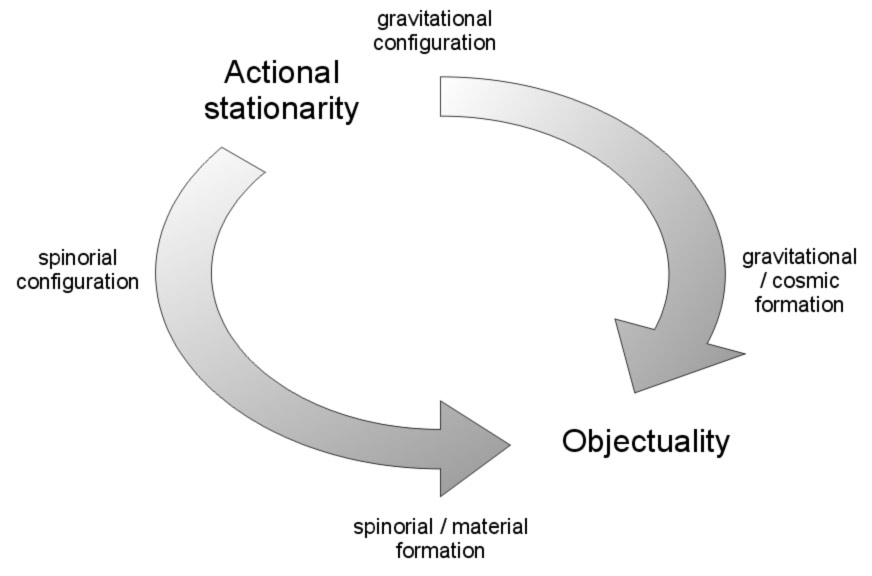
The physical bearings are shown without the inferential and energy distinctions developed in TGT and the Four Chambers scheme.
Sarkar's Four Chambers scheme takes a different route, identifying the (A) objective chamber with propensities, that is, mental or psychic trends. Propensities are not themselves inferences, but constituents of inference, whose counterpart is the Knowing Faculty. This distinction makes considerable sense. Even when a physicist reads a number from a screen, what is perceived is light and colour. Such perception is not accounted for merely by describing neurological computation; it belongs to a more immediate physiological, and perhaps even physical, reality.
As Sarkar associates the Knowing Faculty, the (A) subjective chamber, with expressed energies, associating objective propensities with potential energy is equally plausible. Recall that, in our ontogeneric approach, propensities are objective, rather than qualic in Chalmers's sense. A central argument now emerges: understanding microvita may substantially depend on understanding expressed and potential energies as ontogeneric principles, rather than merely as quantities defined by particular physical Hamiltonians.

To paraphrase Sarkar (1991), energy by itself is blind, but is organized through microvita. With expressed and potential energies inferentially characterized within the Four Chambers framework, we can now explore how TGT informs an ontogeneric realization of cosmology. The inferential qualifications, Propensities and the Knowing Principle, emphatically invoke actual cosmic manifestation, rather than even the most carefully conceived collection of theoretical or laboratory models. This brings the formative sector into focus, complementary to the configurational sector emphasized in TGT's treatment of the characteristic physical bearings. While canonical action and topology provide the required physical precision for articulating the energetic chambers, the common, single-term Lagrangian action \( S=\int L(q,\dot q,t)\,dt, \) retains a central ontogeneric role.
The Four Chambers scheme can be read as a combinatorial articulation of what Sarkar describes in terms of bifurcation and reduction. Paraphrasing, with microvita maintaining equilibrium in the (B) subjective chamber, the B-axis can be identified as bifurcating, while the A-axis can be viewed as bifurcative. Within this four-quadrant scheme, TGT's rotational and directional bearings can be nontrivially cross-related. With the expressed and potential energies already identified, the bearings can pragmatically be arranged along the cosmological perimeter:
With the physical bearings and their associated energies in place, the cosmological picture now admits a meaningful introduction of the sphere of directions, \(S^2\), together with its associated configurational and formative fibre bundles, thereby preparing the ground for a precise account of microvita. In the greater cosmological scheme, the Hopf fibration of S³ thereby controls the configurational sector, encompassing both gravitational and spinorial bearings, while the frame fibration of \(SO(3)\) controls its formative counterpart, articulated in the objectual inference of elements, physical objects, orbital motion, and so forth.
Having thus situated the two fibre bundles within a cosmogenic framework that also distinguishes expressed and potential energies, the standard topological classification of circle bundles over \(S^2\) becomes particularly relevant to microvita. Principal circle bundles over \(S^2\) are classified by their integer first Chern number (Milnor & Stasheff, 1974): \[ n\in H^2(S^2;\mathbb Z)\cong\mathbb Z \qquad \text{where }H^2\text{ denotes the second cohomology group.} \] The two fibrations discussed in TGT belong to distinct classes: \[ \begin{aligned} S^1&\hookrightarrow S^3\longrightarrow S^2 && n=1\qquad\text{(Hopf bundle)},\\[4pt] SO(2)&\hookrightarrow SO(3)\longrightarrow S^2 && n=2\qquad\text{(frame bundle)}. \end{aligned} \] But the classification also includes a trivial circle bundle: \[ \boxed{ S^1\hookrightarrow S^2\times S^1\longrightarrow S^2, \qquad n=0. } \] This third class was neither introduced nor required in the original TGT exposition. Within the present cosmological scheme, however, it offers a distinct topological realization of the central equilibrium associated with \(S^2\). Here, "trivial" does not mean inactive. Rather, the absence of nontrivial global twisting permits a fibrational realization without the configurational or formative characteristic of the other two classes. In ontogeneric terms, this places the neutral realization on the bifurcative, energetic A-axis. The neutral class is thus distinct from, and nonreductive to, the two bearing-related fibrations. Its associated action need not actualize the two terms of the canonical form, but may retain the common, single-term Lagrangian expression: \[ S_0=\int L\,dt. \] It is worth recalling that the Lagrangian, familiar in mechanics and field theory alike, is typically expressed as \(L=T-V\), articulating the energey division of the Four Chambers in ordinary kinetic and potential terms. In this way, the cosmological scheme admits three distinct topological fibrations, which can be understood in close relation to Sarkar's position. Together, they constitute a framework for the equilibrium and inferential degeneration expressed along the axis of reduction.
Outside the cosmological discourse, much of Sarkar's treatment of microvita concerns their biophysical, psychological and cultural implications. Occasionally, however, he also emphasized physics-related properties that appear strikingly reciprocal with the TGT–Four Chambers framework developed here. At the same time, since microvita as particulate entities remain elusive and lack instrumental confirmation, our focus will be on microvitic action, rather than the search for a new type of particle.
The formal (\(K_\Phi\)), topological (\(S^3\), \(S^2\), \(SO(3)\)) and Lagrangian articulations of integral ontogeneric action developed along the inferential axis signify analytical, not causal distinctions. Although the Lagrangian action admits canonicalization, it retains a central, neutral position on the bifurcative axis separating the configurational and formative sectors. Here, the Lagrangian is considered in ordinary kinetic and potential energy terms. In the neutral realization, the triviality extends beyond the bundle topology to its quantitative decomposition. The integral activating wave and its single subwave admit no distinct synthetic composition, while \(K_\Phi\) has no differentiated \(1k\) or \(2k\) realization. The single subwave is therefore, quite literally, neither \(2k=0\) nor not \(2k=0\). Nor does neutrality imply the absence of inference, but rather inferentiality without configurational or formative specialization. The resulting TGT–Four Chambers scheme thus distinguishes three ontogeneric classes: configurational, neutral and formative, each admitting a formal, effective and physical articulation.
Together, the three distinct topological fibre bundles control an integral cosmological scheme of equilibrium and degeneration along a single axis of reduction. In this scheme, objectual physical reality is no longer understood as absolute or stationary. It is a dynamic semblance within the range of inferentiality, investigated by physics through its energetic expressions. Understanding energy exclusively as a property of already constituted physicality risks presupposing precisely what calls for explanation. The TGT–Four Chambers synthesis instead considers expressed and potential energies in their ontogeneric relation at the boundary between configurational and formative sectors. This opens the prospect of extending physical inquiry beyond an exclusively biochemical account of life, and perhaps even toward an understanding of the so-called dark sector of cosmology. In Sarkar's account, microvita organize energy, while both are situated on the “silver line of demarcation between matter and abstract.” In this sense, Microvita Theory invites a reconsideration not merely of what physical reality contains, but of how it becomes intelligible.
In addition to P.R. Sarkar's succinct Four Chambers annotations tabulated above, the following excerpts from his collected discourses are reproduced verbatim and without commentary.
This is a new line of thinking – a new philosophical approach. Here “knower I” or “doer I” are not necessarily the mahat, aham or citta of philosophy. It is a new school of philosophical thought – it has no connection with mahat, aham and citta. (Sarkar, 1991, “Microvita and Cosmology”).
So these microvita may be broadly divided into three categories – first, those coming within the scope of a microscope; secondly, those not coming within the scope of a microscope but coming within the scope of perception as a result of their expression, as a result of their actional vibration; and thirdly, those not coming within the scope of common perception but coming within the scope of a special type of perception which is actually the reflection of conception within the periphery of perception (Sarkar, 1991, “Microvitum, the Mysterious Emanation of Cosmic Factor”).
Microvitum, whether positive or negative, is a very subtle entity, hence it is conveyed through inferences (Sarkar, 1991, “Smell and Microvita – Section C”).
Positive microvitum is pro-ectoplasmic – it is more ectoplasmic than matter. Negative microvitum is pro-materialistic – it is more matter than mind, than ectoplasm (Sarkar, 1991, “Questions and Answers on Microvita – Section B”).
In principle, negative and positive microvita are the same, but their field of activity is different (Sarkar, 1991, “Sadguru and Microvita”).
Inferences are the major waves, but sub-waves are created in them by moving microvita. The major waves function as the controlling waves for the sub-waves (Sarkar, 1991, “Questions and Answers on Microvita – Section H”).
Positive and negative microvita maintain equilibrium in the (B) subjective chamber of the Supreme Attributional Principle. That is why during the bifurcation, the unitary strength remains the same – the subjective and objective having equal value in strength during the phase of reduction (Sarkar, 1991, “Microvita and Cosmology”).
References
Chalmers, D. J. (1995). Facing up to the problem of consciousness. Journal of Consciousness Studies, 2(3), 200–219.
de Broglie, L. (1925/2004). Recherches sur la théorie des quanta [On the theory of quanta] (A. F. Kracklauer, Trans.). Annales de Physique, 10e série, 3.
Emre, S. (2025). Towards a deeper understanding in physics. Neohumanist Review, (4), 6–11, 54–57. https://neohumanistreview.com/2024/12/29/towards-a-deeper-understanding-in-physics/
Hewitson, J. M. (2026). Tantra and the hard problem of consciousness. Neohumanist Review, (7), 12–17, 61–67. https://neohumanistreview.com/2026/05/29/tantra-and-the-hard-problem-of-consciousness/
Milnor, J. W., & Stasheff, J. D. (1974). Characteristic classes (Annals of Mathematics Studies, No. 76). Princeton University Press.
Noether, E. (1918). Invariante Variationsprobleme. Nachrichten von der Gesellschaft der Wissenschaften zu Göttingen, Mathematisch-Physikalische Klasse, 1918, 235–257.
Sarkar, P. R. (1996). Ánanda Sútram (2nd ed.). Ananda Marga Publications.
Sarkar, P.R. (1991), Microvitum in a Nutshell (3rd ed.). Ananda Marga Publications.
Towsey, M. (Ed.). (2011). Eternal dance of macrocosm: An encyclopaedia of matter, mind and consciousness (Vol. 2, 2nd ed.). Proutist Universal.
van den Bovenkamp, F. (2025). The sounds and colours of creation. Neohumanist Review, (4), 18–73. https://neohumanistreview.com/2024/12/29/the-sounds-and-colours-of-creation/
Werner, S. A., Colella, R., Overhauser, A. W., & Eagen, C. F. (1975). Observation of the phase shift of a neutron due to precession in a magnetic field. Physical Review Letters, 35(16), 1053–1055. https://doi.org/10.1103/PhysRevLett.35.1053.